Suppliers
Long-term supplier relationships are something we deeply value at Rituals. Some of our largest partnerships date back to the very beginning of Rituals, reflecting 25 years of shared growth and success. These strong collaborations support ongoing dialogue and continuous improvement on ESG-related topics across the value chain.


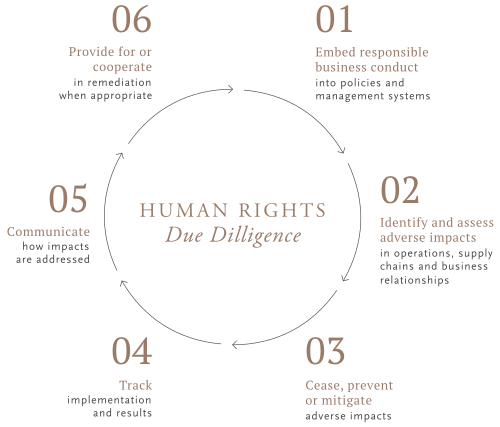
Our human rights strategy
In 2024, we conducted a human rights risk assessment to identify and prioritise our most salient issues. Salient issues are those that pose the greatest risk of negative impacts on people and their human rights throughout our own activities and business relationships.
In 2025, we validated the 2024 results, reviewing for any necessary updates in light of changes to our business (such as new innovations, markets, or suppliers). The list of salient issues remained unchanged from the 2024 assessment and has been used to define priorities for the upcoming year.
Since human rights risks can be linked to specific products, commodities, industries, or countries, we mapped our value chain to ensure that all relevant aspects were carefully considered throughout the process. Find our salient issues and value chain mapped below.
Details on Assesment & Policy
Salient issues
Upstream
Right to adequate standard of living
Livelihood & access to resources
Child labor
Freedom of association & collective bargaining
Fair & just working conditions
Equality & non-discrimination
Own operations
Downstream
2025 actions
Updated Supplier Code of Conduct & Responsible sourcing policy
Launch of 'The Root' our centralized sustainability platform for suppliers
Prioritized supplier engagement, education and visits
Monitoring suppliers in Ecovadis and Sedex
Further roll-out ecovadis in indirect procurement and logistics partners
Further rolled out human rights strategy and targets
ESG in supplier business reviews
Deep-dive high risk ingredient ‘mica’
Our human rights targets
Over the past years, we have strengthened our understanding of human rights risks across our value chain through risk assessments, internal and external stakeholder engagement, and monitoring tools. Building on these insights, we have established two human rights targets that reflect both our responsibility and our ambition. They focus on where our influence is strongest—our direct suppliers—while also looking beyond to address deeper systemic challenges in the wider value chain.
target 1
First, we aim to engage 90% of our key direct suppliers in ongoing human rights due‑diligence programmes by 2027, moving beyond traditional monitoring via tools, to deeper partnerships through training, supplier visits, on‑site dialogue, and shared improvement plans.
target 2
Second, by 2028 we will complete living-wage gap assessments for 100% of our key direct suppliers, followed by a commitment that by 2030, all key direct suppliers declare that they pay a living wage to their own employees and assess wage gaps within their high-risk suppliers.
Across these two targets, we are building on strong foundations, including our supplier sustainability engagement programme, established monitoring tools, and long-standing partnerships that enable open dialogue and joint problem-solving. Additionally, we are also aiming to improve the traceability to origin of our identified priority raw materials to ensure we’re building transparency and are better able to assess nature impacts and human rights risk.
Moreover, we are expanding our human rights supplier program, combining Sedex and EcoVadis insights with on‑site social compliance visits, dialogues on traceability, targeted improvement plans, and practical training for suppliers. This approach allows us to build capacity and tailor support based on each suppliers’ risk exposure and maturity level.


Supplier ESG performance
Creating a complete picture of our suppliers and their own practices is a crucial step towards meeting our commitments to support and respect human rights within our value chain. We use EcoVadis, a provider of independent business sustainability ratings, as a supplier assessment platform to analyse suppliers’ sustainability and corporate responsibility practices and to encourage an ongoing supplier relationship based on continuous improvements.
Read more

10% Profit for Impact
Read more
Human rights risk assessment & policy 2025
Based on our geographical and operational footprint, a scan of different sources including a peer analysis, desktop research, and internal stakeholder engagement, we compiled an exhaustive list of potential human rights at risk across our value chain. To ensure we prioritised the most significant human rights impacts, we assessed the severity (the scale, scope, and irremediability) and likelihood of the impacts throughout our value chain.
To safeguard and promote human rights throughout the value chain and minimise human rights risks, we have a set of preventive measures concerning our own business area and our direct suppliers. We continuously review and improve those preventive measures in light of our ongoing risk management process. See Image for the mapping of our salient human rights issues across the value chain and corresponding preventive measures. You can read more about our salient issues in our Human Rights Policy (2024).
Details of Human Rights Policy 2024 (PDF)
As part of our supplier ESG performance approach, we rolled out our climate programme among suppliers in 2025. Since a large share of our emissions occurs in our value chain, supplier collaboration is essential to help reduce our Scope 3 emissions over time. We asked all key suppliers to set SBTi targets and develop decarbonisation plans, and we support them throughout this journey. In 2026, we will also begin collecting Product Carbon Footprint data for prioritised suppliers and products to improve emissions insights and identify further reduction opportunities across our value chain.
For a more in-depth understanding of potential human rights risks, we use SEDEX. Our aim is for 100% of our Tier 1 direct suppliers to complete SEDEX onboarding through the self-assessment questionnaire (SAQ). To date, we have onboarded 94% of our direct suppliers. The remaining share mainly relates to suppliers where alternative, equivalent third-party certifications (such as SA8000) are used, and suppliers who are onboarding to SEDEX based on mutually agreed implementation timelines.
2025 values
2024 | 2025 | |
% of onboarded direct suppliers meet their updated target of the total required score and the minimum score per pillar | 45% | 70% |
% of direct suppliers completed SEDEX onboarding | 69% | 94% |
SEDEX Audits across our direct supplier base | 54 | 49 |
EcoVadis
The EcoVadis assessment is one of the most widely recognised evaluation tools for sustainability performance. It includes a comprehensive survey covering environmental practices, labour and human rights, ethics, and sustainable procurement.
We require our suppliers to complete the EcoVadis assessment and expect all onboarded suppliers to achieve at least a “Good” rating, corresponding to a total score of 45–64 points. For key strategic suppliers, our target is an “Advanced” rating, with a total score of 65–84 points. In addition, we now require all suppliers to achieve a minimum of 45 points in each EcoVadis pillar, as well as in their overall score.
As shown in the table, a majority of onboarded suppliers meet or exceed our current target thresholds. At the same time, we believe it is important to include a minimum score for each pillar within our target setting. This raises the bar and supports continuous improvement across all areas. In 2025, 70% of our onboarded suppliers met the target for both the required overall score and the minimum score per pillar.
We are also onboarding our strategic indirect suppliers to EcoVadis, representing 50% of our managed indirect spend in 2025. To date, suppliers representing 43% of our indirect spend have been onboarded to EcoVadis.
Supplier scoring
breakdown
Not onboarded
33%
Insufficient
0.0%
Partial
4%
Good
27%
Advanced
34%
Outstanding
2%
Assessment themes

Environment

Labour & Human Rights

Ethics

Sustainable Procurement
SEDEX
The self-assessment questionnaire is only the first step in identifying potential risks, as we also carry out additional onsite audits through SEDEX.
In 2025, we conducted 49 audits across our direct supplier base, including announced, unannounced, and semi-announced audits. We review the findings with suppliers and, where relevant, support them in implementing corrective actions to address issues and drive continuous improvement. Required follow-up actions must be completed within six months, or sooner where the severity of the impact demands it. We also require our strategic indirect suppliers with physical sites to complete SEDEX onboarding, with a target of 100%.